
The The ROI in Flexible Benefits measures the value the company obtains for each euro invested in the benefits plan., comparing that cost with the quantifiable benefits it generates: tax savings for the employee, lower staff turnover, less absenteeism, and productivity gains associated with a more engaged team. Unlike other HR investments, here the return has two sides:
Before applying any formula, it is advisable to have a clear understanding of the building blocks involved: On the benefit (return) side:
The simplest way to put it is:
Where
The result, multiplied by 100, is read as the percentage return on investment. If the result is, for example, 3x, it means that for every euro invested in the plan, the company recovers three. For the calculation to be reliable, some minimum variables are needed: the plan adoption rate (what percentage of staff actually uses it), the average salary, the annual turnover rate, the days of leave per person, and the budget allocated to the plan.
Instead of building this formula manually in a spreadsheet, Edenred offers a ROI calculator for businesses that automates the process. You only need to enter six pieces of organisational data:
With that data, Our tool automatically calculates three return blocks and combines them into a final summary with the ROI multiple. (for example, «you get 3x your investment back»):
Calculate the current cost of turnover (based on the number of departures and the cost of replacing each person) and apply a conservative reduction in turnover of 10% thanks to the benefits scheme, based on a benchmark turnover rate of 17% for Spain according to Randstad Research and on Gallup’s replacement cost estimates, which put that cost at between 40% and 200% of the salary, depending on the role.
Estimate the value of productivity using the employee's salary as a reference and apply a minimum increase of 1%, a deliberately conservative figure compared with the 17–44% improvement ranges cited by some meta-analyses on recognition and commitment at work, in order to avoid inflated projections.
Part of the average rate of Absenteeism in Spain (around 6.6% according to Randstad Research) and applies a conservative reduction of 10%, well below the 17.7% cited by some studies on wellbeing and work-life balance schemes, to calculate the number of sick days avoided and their associated cost. The calculator adds up the three components, compares them with the annual budget allocated to the scheme and displays the return multiple, as well as allowing generate a PDF report personalised with the company name.
Let's imagine a company with this data:
When these values are entered into the Edenred calculator, the tool automatically translates the reduction in staff turnover, improvement in productivity, and savings on absenteeism into euros, and compares them with the €12,000 invested. The typical result in scenarios of this type is usually several times the return on investment, although the exact figure depends on how the six input parameters are combined.
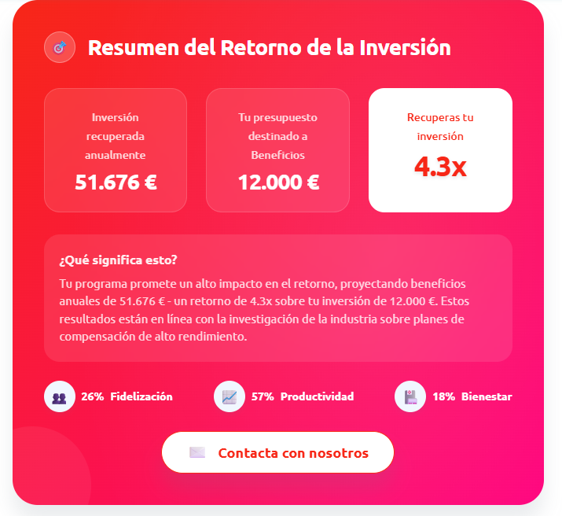
The calculator itself includes an important notice that should not be overlooked: these are projections based on conservative assumptions and benchmark research (INE, Randstad Research, Gallup, Adecco Group Institute, among others), not a guarantee of results. The actual impact may vary depending on company culture, workforce demographics, how the plan is communicated internally, and prevailing labour market conditions.
For this reason, ROI should be treated as an estimation and argumentation tool – very useful for justifying the budget to management – and reviewed with actual company data once the plan has been in progress for a while, comparing turnover, absenteeism, and effective participation with what was projected at the start.
Launching a Flexible Benefits plan without calculating its ROI is equivalent to to invest blindly The cost is known, but the return is not. And without that figure, it's much more difficult to defend the budget to management, justify its renewal year after year, or compare it with other HR levers that compete for the same resources.
Calculating the ROI before implementing the plan provides a quantifiable argument.It allows businesses to anticipate, based on their own data – staff size, average salary, turnover, and absenteeism – how many times the investment is recouped. This number turns an HR decision into a business decision, using the same language that finance understands.
But the calculation shouldn't remain an initial estimate. Measuring the ROI once the plan is underway is what confirms if those projections are being metif actual participation matches that estimated, if turnover drops as much as predicted, if absenteeism improves at the expected rate. This comparison between what was projected and what actually happened is what allows the plan to be adjusted—more internal communication, different products, a different budget—rather than being kept unchanged for years.
Ultimately, calculating ROI justifies the initial investment; measuring it continuously is what sustains it over time. Edenred ROI calculator help take that first step — the initial projection — with a documented methodology and a downloadable PDF report, ready for discussions with management or finance.