
5th May 2026

How do you calculate the savings from flexible working?

Girl calculating her flexible compensation savings with a calculator

With the Flexible Compensation Can you increase your net salary over €1000 a year without your company incurring any additional costs. Savings are achieved by reducing your taxable income: a part of your gross salary is allocated to products such as food, transport, or childcare, which are exempt from income tax, meaning you pay less tax and have more money in your pocket.

In this article, we explain how to calculate it step by step, with practical examples based on real salaries. And if you prefer to skip the numbers, at the end you will find the Edenred calculator to get your exact simulation in less than a minute.

Table of contents

Calculate flexible remuneration savings step by step

1. Identify your gross annual salary and your personal income tax bracket.

This is the starting point for any calculation and one of the most important steps to achieving a realistic savings simulation. gross annual salary determines your initial taxable income, whereas your personal income tax bracket This defines the percentage of tax you will pay. Both factors directly influence how much you can save with flexible remuneration.

To begin, locate your gross salary on your contract or annual payslip. For example, if your salary is €30,000 gross per year, this is the value you'll use as a reference. From here, you must Identify which income tax bracket you are in, as each band applies a different tax rate. Knowing your band will help you more accurately estimate how much tax you will save when you reduce the taxable base thanks to flexible remuneration.

Personal income tax brackets Type of retention
Up to €12,450 19%
£12,450 – £20,200 24%
£20,200 – £35,200 30%
£35,200 – £60,000 37%
£60,000 – £300,000 45%
Over €300,000 47%


Example applied to a gross salary of 30,000:

The relevant sections would be the following:

  • Up to €12,450 → 19%
  • From 12,450 € to 20,200 € → 24%
  • From €20,200 to €35,200 → 30%

In this case, the salary of €30,000 falls within the bracket from €20,200 to €35,200, with a marginal rate of 30%. This does not mean that you pay a 30% for your entire salary., but only for the part of the salary that falls within that bracket.

This is how your taxation would be distributed:

  • Up to €12,450 → 19%
  • From €12,450 to €20,200 (€7,750) → 24%
  • From €20,200 to €30,000 (€9,800) → 30%

The percentage corresponding to the last stage you are in is known as Marginal personal income tax, and it is key to calculating your potential savings with flexible remuneration.

Have you got lost? We'll calculate it for you in less than a minute!

2. Check which products are exempt from income tax and their limits

Before continuing with the calculation, it is important to identify which flexible remuneration plan products benefit from tax exemption and up to what amount.

These limits determine the real savings you will be able to obtain and prevent you from exceeding the amounts permitted by regulations.

products you can choose from will depend on the Flexible remuneration plan implemented in your company.


Banner Request Flex Demo


3. Determine which part you will allocate to flexible remuneration and calculate your new taxable base

Once you know your gross salary and your personal income tax bracket, the next step is to Decide how much you want to allocate to flexible benefits And how will this affect your taxable base? This decision will depend on the products offered by your company (such as food, transport, childcare or training) and the tax limits established for each.

For example, if you decide to allocate 1,496€ for transport (the maximum that can be allocated per year) and €2,420 for food (€11/day for 20 days a month, for 11 months), A gross amount of €26,084 remains., What will be the new tax base.

4. Calculate how much you will pay in income tax and the final savings from flexible remuneration

To this tax base a personal income tax rate of 14.26% is applied, meaning you will pay €3,719.51 in income tax and have €22,364.49 in net salary remaining, with a saving of €1,100.20.

In a nutshell:
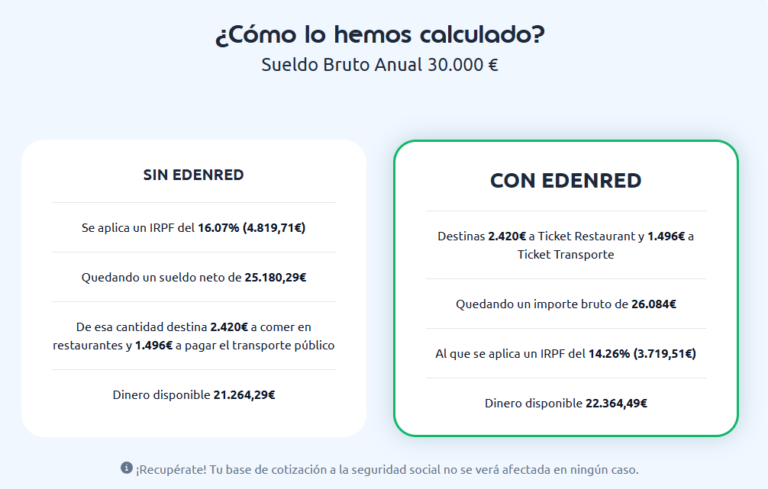
Example flexible benefits calculator Edenred Use our flexible benefits savings calculator!

Which flexible benefits products offer the most savings?

Savings depend on the type of product and its tax exemption level:
  • Restoration Significant savings thanks to the daily exemption
  • Public transport → it depends on how much you use it, the more you use it the more you save (up to €1,500 per year tax-free)
  • Nursery being compatible with other state and regional aid is very advantageous
  • Health insurance According to the policy you stipulate, it can be a very convenient saving.
If you want to compare savings between products, the Edenred flexible remuneration savings calculator will show you which offers the most benefit according to your case.

Does flexible remuneration affect my contributions?

No. Although you pay less income tax, you continue to contribute as usual, as the contribution is based on the total gross salary, not on the taxable base after flexi-benefit has been applied. This means that it doesn't affect your pension, benefits or employment rights.

What happens if I don't spend the entire allowance?

It will depend on each company's policy, but generally:
  • In products like catering or transport, if you don't consume the assigned amount, it may be lost or carried over.
  • In the nursery, spending is usually adjusted monthly, so there isn't usually any surplus or waste.
I want to calculate my savings with Edenred!

I am an expert in employee benefits, specialising in strategic communication and consulting. I currently work at Edenred Spain as a Customer Success Manager, where I support organisations in the effective implementation of their compensation and benefits plans. My goal is to maximise the perceived value of these solutions as a key lever for talent attraction and retention.

Follow me on: