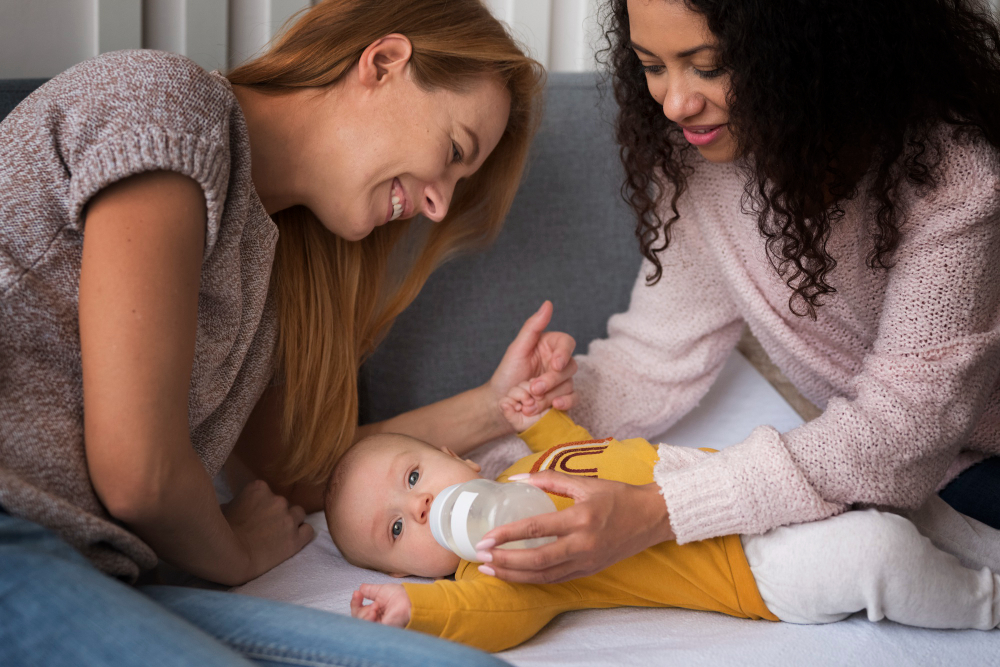
What is the breastfeeding leave?
Maternity leave is a paid employment right which allows time to be taken during the working day to care for a child during their first 9 months of life (although this can be extended up to 12 months).
Although it was traditionally associated with breastfeeding, nowadays it doesn't depend on the baby's feeding method. It can be enjoyed whether there is breastfeeding or if the child is formula-fed or bottle-fed.
For this reason, the leave currently serves a much broader purpose: favour the Work-life balance during the first few months after birth or adoption.It is a right:
- Individual, that is to say, it applies to each parent separately.
- Non-transferable between father and mother.
- Applicable to any worker, irrespective of whether or not there is a collective agreement expressly regulating it.
- Compatible with various enjoyment options, which we shall see below.
In Spain, this right is regulated primarily in the Article 37 of the Workers' Statute, although some collective agreements may improve upon the conditions established by law.
How long is the breastfeeding leave?
The overall duration of the breastfeeding leave lasts until the child turns 9 months. In some cases, it can be extended up to twelve months, although that extension may involve financial adjustments or specific conditions that must be reviewed on a case-by-case basis.
If it is accumulated to be used as whole days, it is calculated in working days or effective shifts, not in calendar days.
Notice period: how much advance notice must be given to the company
The Workers' Statute sets a minimum notice of 15 days, unless the collective agreement establishes a different period. When the agreement does not clarify whether calendar or working days are counted, the company's usual criteria apply. From HR it is always advisable to request it in writing, with extra notice so that the team can be organised.
Who can apply for the breastfeeding leave?
Currently, the breastfeeding leave is a non-transferable right of each parent, provided that both work.
This means that it can be requested by: the mother, the father, parents in same-sex couples, the parent in single-parent families, adoptive parents, and those who hold guardianship for the purpose of adoption.
However, in order to be able to take the breastfeeding leave, it is necessary to meet a series of minimum requirements:
- To be an employee and be bound to a company by an employment contract.
- The birth, adoption, guardianship for adoption, or foster care having taken place of the minor.
- To be in a situation of being registered or treated as registered with the Social Security system, depending on the employment type.
- Having finished the maternity or paternity leave, since the breastfeeding leave begins once this period has ended.
- Yes both parents work, each one has a individual right to request the leave. Nevertheless, in certain cases related to the manner in which it is taken simultaneously or accumulated, the company may apply the provisions set out in the Workers' Statute or in the collective agreement to ensure the proper functioning of the organisation.
Can the father take breastfeeding leave?
Yes, the father (or the non-birth parent) has the exact same right as the mother Enjoy your breastfeeding leave, provided that you meet the legally established requirements.
This is not leave «transferred» by the mother, but a right of one's own.
This distinction is important because the belief still exists that the mother must give it up for the father to use it, when that is no longer how it works.
How can breastfeeding leave be taken?
The legislation allows various ways of exercising this rightChoosing one or the other will depend on family needs, the collective agreement and the agreement with the company.
The main options for taking breastfeeding leave are:
Absence of one hour a day
It is the best-known modality: the worker can be absent one hour daily of their working day until the child reaches nine months of age. It is not necessary for that hour to coincide with the beginning or the end of the working day.
Reduce working hours
Instead of taking an hour off, you can choose to reduce the working day by two separate half-hours.
For example:
- to come in half an hour later;
- leave half an hour early.
This type of arrangement usually makes it easier to balance work and personal life when working hours are rigid.
Accumulating leave in full days
Instead of enjoying one hour a day, it is possible accumulate all those hours and convert them into full days of leave which can be enjoyed after maternity and paternity leave. This right is regulated in the Royal Decree-Law 2/2024.
Who pays for the breastfeeding leave?
The breastfeeding leave is a paid leave, but who covers its cost depends on the period in which it is taken.
- Until the child turns 9 months old, the company pays for the breastfeeding leave.During this period, the employee maintains their salary and continues to provide services under the conditions set out by the chosen method of taking leave (reduced working hours, daily absence or accumulated leave).
- If the leave is extended up to 12 months (extension) the working person experiences a proportional reduction of their salary corresponding to the working time no longer worked. To compensate for this reduction, the Social Security can recognise a subsidy for the co-responsible exercise of infant care.
How is accumulated breastfeeding leave calculated?
When the employee chooses to accumulate the hours into full working days, the calculation is done in three steps:
- Calculate the total hoursworking days from the return to work until the baby turns 9 months old are multiplied by 1 hour per day.
- Convert those hours into full daysthe total hours are divided by the person's working hours.
- Apply for the permission in advanceby law, the minimum notice period is 15 days (or the period set by the collective bargaining agreement), indicating the specific dates on which you wish to take them.
The formula, in short, would be:
Breastfeeding leave days = (working days up to the infant's 9 months × 1 hour) ÷ hours of the daily working day
Example of accumulated breastfeeding break calculation
Imagine a professional with full-time hours of 8 hours a day, from Monday to Friday, who returns to work when her baby is 4 months old and decides to take her leave as accumulated full days rather than taking it day by day. Here is how she can calculate it:
- Step 1 — Working days up to 9 months: From the baby's 4th to 9th month there are 5 months, about 21.7 weeks. At 5 working days per week: 21.7 × 5 ≈ 108 working days.
- Step 2 — Total leave hours: The working days are multiplied by the daily hours to which they are entitled: 108 days × 1 hour = 108 hours.
- Step 3 — Conversion to full days: The 108 hours are divided by their daily working hours of 8 hours: 108 ÷ 8 = 13.5 working days accumulated leave.
That is to say, this worker could be absent 13 and a half days, in a block, right after her maternity leave, instead of leaving an hour early each day during those 5 months.
If the same person were to work part-time (4 hours a day), the result changes: 108 hours ÷ 4 hours = 27 working days. The number of days is higher because the leave is always calculated in hours, and the fewer hours the working day has, the more full days are needed to use up those same hours.
Breastfeeding leave within a work-life balance policy
When maternity and paternity leave ends and the breastfeeding leave begins, many families face another challenge: finding and paying for a nursery school place. This is where benefits such as the childminder from Edenred make sense, by allowing employees to cover childcare expenses (0-3 years) exempt from income tax, as part of a flexible remuneration plan.
Offering this type of benefit alongside clear management of nursing leave reinforces the company's value proposition regarding work-life balance, especially in the baby's early years when family needs are greatest.